


Skip to content

Our Approach: From Manufacturing Challenge to Engineered Solution

Understanding the problem is just as important as engineering the solution.

Every manufacturing application begins with a set of requirements. But those requirements don't always tell the full story.

That's how we work to unlock the additive advantage.

A component may need to perform a specific function, fit within an existing process, or address a recurring production challenge. Understanding those conditions is essential to developing a solution that makes practical sense.

At JEL Solutions, we bring manufacturing experience, engineering judgment, and additive manufacturing expertise together to evaluate opportunities and develop application-specific solutions.

We consider more than what can be manufactured. We look at how a solution will function, how it fits into the operation, and whether additive manufacturing offers an appropriate approach.

The Right Solution Requires More Than the Right Technology.

Bringing together process understanding, mechanical design, and design for additive manufacturing.

Additive manufacturing opens possibilities for creating specialized components and applications. But making effective use of those possibilities requires more than knowing how to operate the technology.

It requires an understanding of the manufacturing process, the functional requirements of the component, and the design considerations that influence how it can be produced.

JEL brings these disciplines together to evaluate applications from multiple perspectives.

Rather than treating the existing design as the only possible answer, we consider how the component functions, how the process operates, and where additive manufacturing may provide a suitable alternative.

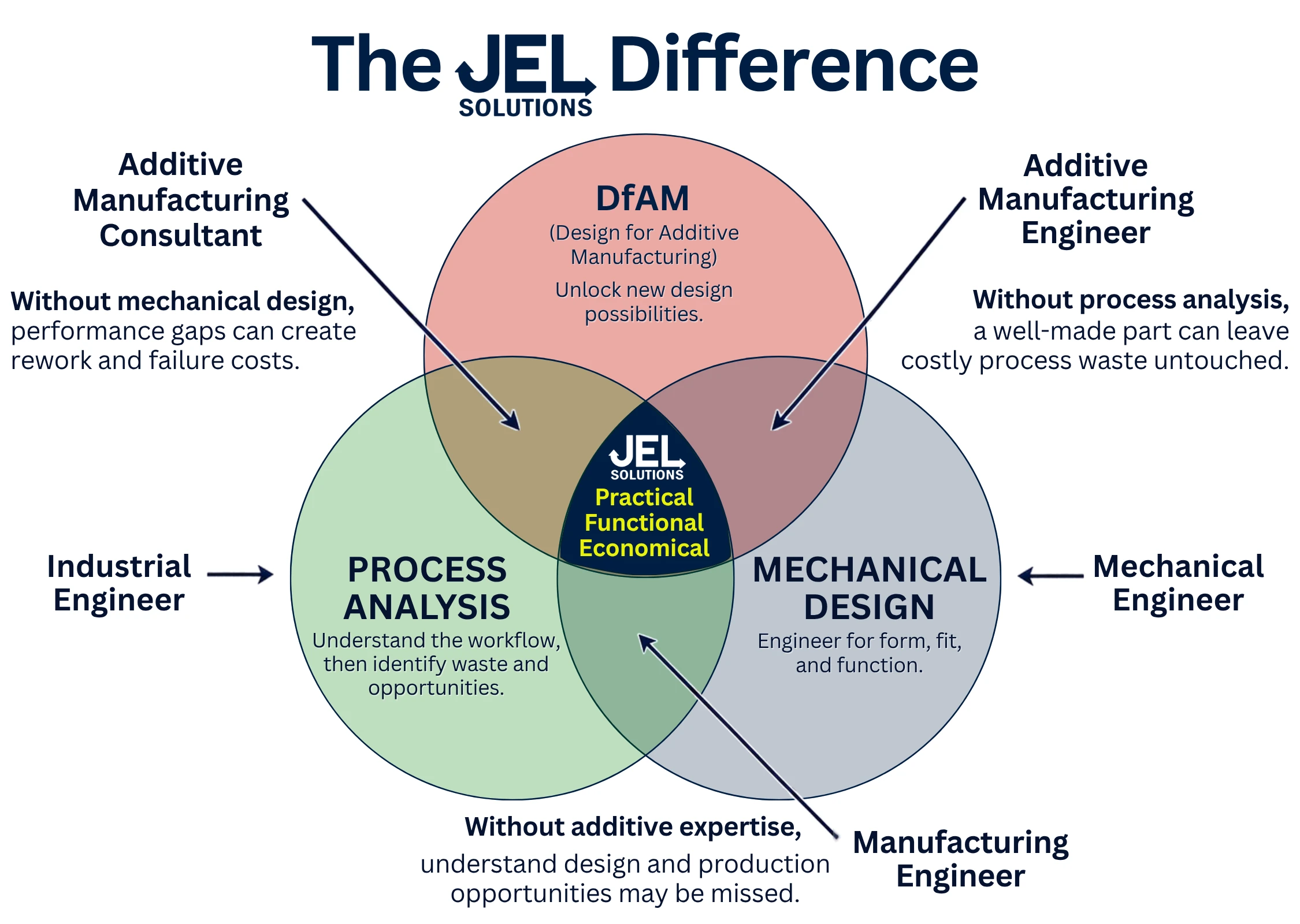
The JEL Difference: three overlapping circles. DfAM (Design for Additive Manufacturing): unlock new design possibilities. Process Analysis: understand the workflow, then identify waste and opportunities. Mechanical Design: engineer for form, fit, and function. Single roles cover only part of the picture: an industrial engineer covers process analysis; a mechanical engineer, mechanical design; an additive manufacturing consultant, DfAM and process analysis (without mechanical design, performance gaps can create rework and failure costs); an additive manufacturing engineer, DfAM and mechanical design (without process analysis, a well-made part can leave costly process waste untouched); a manufacturing engineer, process analysis and mechanical design (without additive expertise, understand design and production opportunities may be missed). JEL Solutions sits at the centre, where all three overlap: practical, functional, economical.
View full size (opens the JEL Difference graphic in a new tab)

Three Disciplines. One Integrated Engineering Perspective.

  • Understand the workflow. Identify the opportunity.

    Before proposing a solution, it's important to understand the manufacturing environment in which it will operate.

    Process analysis helps identify the requirements, constraints, and operational conditions that influence an application's success.

    By examining how work is performed, JEL can better understand where a specialized component, tooling application, or design change may be appropriate.

    Key Considerations

    • How the current process operates
    • Where challenges or inefficiencies occur
    • How components interact with equipment and people
    • What a successful application needs to accomplish
    The JEL Difference: three overlapping circles. DfAM (Design for Additive Manufacturing): unlock new design possibilities. Process Analysis: understand the workflow, then identify waste and opportunities. Mechanical Design: engineer for form, fit, and function. Single roles cover only part of the picture: an industrial engineer covers process analysis; a mechanical engineer, mechanical design; an additive manufacturing consultant, DfAM and process analysis (without mechanical design, performance gaps can create rework and failure costs); an additive manufacturing engineer, DfAM and mechanical design (without process analysis, a well-made part can leave costly process waste untouched); a manufacturing engineer, process analysis and mechanical design (without additive expertise, understand design and production opportunities may be missed). JEL Solutions sits at the centre, where all three overlap: practical, functional, economical.
    Highlighted: Process Analysis
  • Engineer for function, fit, and performance.

    A specialized component must do more than take the right shape.

    Its geometry, interfaces, mechanical requirements, and operating conditions all influence how it should be designed.

    JEL applies mechanical design principles to consider the functional requirements of a component and how it interacts with the surrounding application.

    Key Considerations

    • Component geometry and fit
    • Functional and mechanical requirements
    • Interfaces with existing equipment
    • Loading, environmental, and performance considerations
    The JEL Difference: three overlapping circles. DfAM (Design for Additive Manufacturing): unlock new design possibilities. Process Analysis: understand the workflow, then identify waste and opportunities. Mechanical Design: engineer for form, fit, and function. Single roles cover only part of the picture: an industrial engineer covers process analysis; a mechanical engineer, mechanical design; an additive manufacturing consultant, DfAM and process analysis (without mechanical design, performance gaps can create rework and failure costs); an additive manufacturing engineer, DfAM and mechanical design (without process analysis, a well-made part can leave costly process waste untouched); a manufacturing engineer, process analysis and mechanical design (without additive expertise, understand design and production opportunities may be missed). JEL Solutions sits at the centre, where all three overlap: practical, functional, economical.
    Highlighted: Mechanical Design
  • Design with the manufacturing method in mind.

    Additive manufacturing introduces design possibilities and manufacturing constraints that differ from those of conventional production methods.

    Design for Additive Manufacturing, or DfAM, considers how component geometry, material selection, build orientation, process limitations, and intended use influence the final application.

    Applying these considerations early can help determine whether additive manufacturing is technically and practically suitable.

    Key Considerations

    • Geometry and design flexibility
    • Manufacturing process requirements
    • Material and performance considerations
    • Opportunities for application-specific design refinement
    The JEL Difference: three overlapping circles. DfAM (Design for Additive Manufacturing): unlock new design possibilities. Process Analysis: understand the workflow, then identify waste and opportunities. Mechanical Design: engineer for form, fit, and function. Single roles cover only part of the picture: an industrial engineer covers process analysis; a mechanical engineer, mechanical design; an additive manufacturing consultant, DfAM and process analysis (without mechanical design, performance gaps can create rework and failure costs); an additive manufacturing engineer, DfAM and mechanical design (without process analysis, a well-made part can leave costly process waste untouched); a manufacturing engineer, process analysis and mechanical design (without additive expertise, understand design and production opportunities may be missed). JEL Solutions sits at the centre, where all three overlap: practical, functional, economical.
    Highlighted: Design for Additive Manufacturing (DfAM)
  • Practical. Functional. Economical.

    The opportunity lies in understanding how these three disciplines influence one another.

    An application may be mechanically sound but difficult to manufacture economically. A component may be well suited to additive manufacturing but fail to address the broader operational problem. A proposed process improvement may require design expertise to become a practical physical solution.

    JEL's integrated approach considers these relationships as part of developing applications that meet functional requirements and make sense for the intended manufacturing environment.

    The objective isn't to use additive manufacturing simply because it is available.

    It's to identify when engineering-led additive manufacturing offers an appropriate way to address the challenge.

    The JEL Difference: three overlapping circles. DfAM (Design for Additive Manufacturing): unlock new design possibilities. Process Analysis: understand the workflow, then identify waste and opportunities. Mechanical Design: engineer for form, fit, and function. Single roles cover only part of the picture: an industrial engineer covers process analysis; a mechanical engineer, mechanical design; an additive manufacturing consultant, DfAM and process analysis (without mechanical design, performance gaps can create rework and failure costs); an additive manufacturing engineer, DfAM and mechanical design (without process analysis, a well-made part can leave costly process waste untouched); a manufacturing engineer, process analysis and mechanical design (without additive expertise, understand design and production opportunities may be missed). JEL Solutions sits at the centre, where all three overlap: practical, functional, economical.
    Highlighted: JEL Solutions, where all three overlap

Understand the Process Before Changing the Part.

Operational understanding and Continuous Improvement thinking inform how we approach engineering challenges.

Manufacturing problems rarely exist in isolation.

A component, fixture, or tool is part of a larger operation involving equipment, materials, people, and established workflows.

That's why JEL approaches application development with an understanding of manufacturing operations and Continuous Improvement principles.

Rather than assuming the first visible issue is the underlying problem, we work to understand the conditions that contribute to the challenge.

This perspective helps inform engineering decisions and identify where additive manufacturing may provide a practical opportunity.

GEMBA: Understanding the Work Where It Happens

GEMBA is a Continuous Improvement principle centered on understanding work at the place where it is performed.

When appropriate to the engagement, JEL may work with customers to observe operational conditions, discuss challenges with the people involved, and better understand how an application needs to function.

This can reveal details that drawings, specifications, and initial project descriptions may not fully capture.

The goal is not simply to make a different part. It's to understand whether a better application is possible.

See Engineering in Action

A Clear Path from Opportunity to Implementation.

A structured process helps turn manufacturing requirements into evaluated, authorized, and practical applications.

Every customer engagement has different requirements.

Some begin with an operational challenge that needs investigation. Others begin with an existing design or defined component requirement.

JEL uses a structured project approach to understand the opportunity, establish expectations, develop the authorized work, and evaluate the solution before implementation.

The activities and level of involvement vary depending on the nature of the project.

  1. Stage 1

    Discover Opportunities

    Understand the challenge and identify potential applications.

    We begin by learning about the customer's situation.

    This may involve a manufacturing challenge, an existing design, a specialized component requirement, or an opportunity to improve an established application.

    The objective is to develop an initial understanding of the problem, operating conditions, desired outcome, and whether further evaluation may be worthwhile.

    • Initial customer discussions
    • Review of the challenge or application
    • Preliminary requirements gathering
    • Identification of potential opportunities

    Stage Outcome: A shared initial understanding of the opportunity and possible next steps.

  2. Stage 2

    Define & Confirm the Project

    Establish the requirements and expectations.

    When an opportunity warrants further consideration, JEL works with the customer to define the proposed project.

    This includes clarifying the technical requirements, deliverables, responsibilities, timing, commercial terms, and appropriate evaluation criteria.

    A clear project definition helps establish what the work is intended to accomplish and what will be required from each party.

    • Review functional and technical requirements
    • Define scope and deliverables
    • Establish project expectations and responsibilities
    • Identify evaluation and acceptance criteria
    • Confirm proposed commercial terms and schedule

    Stage Outcome: A defined project proposal or scope for customer consideration.

  3. Stage 3

    Authorize the Work

    Confirm approval before proceeding.

    Before beginning work requiring authorization, JEL and the customer establish the appropriate agreement to proceed.

    This helps ensure that the scope, responsibilities, project requirements, and commercial expectations are understood.

    Authorization to begin design or development does not automatically represent approval for unrestricted production or operational use.

    • Review the proposed scope and terms
    • Address outstanding project questions
    • Confirm necessary customer approvals
    • Establish authorization to proceed

    Stage Outcome: An authorized project with agreed responsibilities and next steps.

  4. Stage 4

    Design & Build

    Develop the application around its intended requirements.

    Following authorization, JEL carries out the agreed engineering and manufacturing activities.

    Depending on the project, this may include evaluating an existing design, developing new geometry, refining a component, selecting an appropriate additive manufacturing process, and producing a prototype or agreed application.

    The work remains guided by the project's defined technical and functional requirements.

    • Engineering and design development
    • Application-specific design evaluation
    • Additive manufacturing process considerations
    • Prototype or component production, as authorized
    • Coordination of agreed project requirements

    Stage Outcome: A developed application or component ready for the agreed evaluation activities.

  5. Stage 5

    Evaluate the Solution

    Determine whether the application meets the agreed requirements.

    A manufactured component is not automatically a validated solution.

    Evaluation helps establish whether an application performs as intended and whether further adjustments or testing are necessary.

    JEL works with the customer to review the application against agreed criteria, with testing and validation responsibilities defined according to the project.

    • Review of the manufactured application
    • Evaluation against functional requirements
    • Coordination of appropriate customer testing
    • Assessment of necessary refinements
    • Documentation of relevant findings where agreed

    Stage Outcome: An evaluated application with documented or otherwise agreed findings and next-step decisions appropriate to the project.

  6. Stage 6

    Implement & Support

    Move forward with an approved application.

    Once the necessary evaluation and approvals are complete, the customer and JEL determine the appropriate implementation or production steps.

    Depending on the engagement, JEL may support agreed application refinements, subsequent component production, or additional manufacturing opportunities.

    Implementation and ongoing services are governed by the applicable project scope and customer authorizations.

    • Confirm required approvals for intended use
    • Coordinate agreed implementation support
    • Address authorized refinements
    • Support appropriate repeat production
    • Identify potential follow-on applications

    Stage Outcome: An approved application supported according to the agreed project requirements.

Workflow Clarification

The six stages describe JEL's overall customer-project approach.

The sequence and activities may vary based on whether a customer begins with a manufacturing challenge, an established design, or a repeat-production requirement.

Not all projects require on-site observation, new design work, prototyping, or the same evaluation activities.

Customer approvals, technical validation, and authorization for production use must be established according to the requirements of each engagement.

Start a Project Discussion

Engineering Works Better with the Right Collaboration.

Understanding the application means understanding the people, processes, and requirements surrounding it.

Successful application development depends on more than technical design.

The people who operate equipment, maintain production systems, evaluate quality, and approve manufacturing decisions often bring different perspectives to the same challenge.

JEL works with customers to understand these perspectives and incorporate relevant information into the engineering process.

Our role is to contribute specialized engineering and additive manufacturing expertise while working alongside the customer's existing knowledge of its products, processes, and operational requirements.

Depending on the engagement, relevant information may include:

  • The component's intended function
  • Existing designs, drawings, or specifications
  • Operating and environmental conditions
  • Mechanical and material requirements
  • Production quantities and timing
  • Relevant cost or operational considerations
  • Performance and acceptance criteria

These details help inform whether an additive manufacturing application is technically and practically appropriate.

Different stakeholders may contribute at different stages.

Operations and maintenance personnel can provide insight into how a component is used.

Engineering personnel can help define functional and technical requirements.

Quality stakeholders may identify testing, consistency, or application-approval considerations.

Business and procurement decision-makers can clarify commercial objectives and authorization requirements.

JEL's collaborative approach helps connect these perspectives throughout the appropriate stages of the engagement.

Not every manufacturing problem should be addressed through additive manufacturing.

Material properties, mechanical performance, operating conditions, manufacturing economics, and application risks all affect suitability.

JEL considers these factors when evaluating potential applications and works with customers to establish the necessary requirements and validation approach.

The right manufacturing decision is the one that makes sense for the application.

Explore Our Solutions

From Engineered Concept to Practical Application.

Clear expectations and appropriate evaluation help move a promising solution toward real-world use.

Developing an engineered application is only part of the process.

Before a solution is put into use, it is important to establish whether the relevant requirements have been met and whether the necessary approvals are in place.

JEL works with customers to coordinate evaluation and implementation requirements appropriate to the project.

Our approach emphasizes clear communication, defined responsibilities, and practical decision-making throughout the engagement.

What You Can Bring to the Conversation

You don't need a fully developed engineering specification to contact JEL.

Helpful starting information may include:

  • A description of the manufacturing challenge
  • Photographs or details of the application
  • Existing drawings, CAD files, or component specifications
  • The intended function and operating environment
  • Known performance or material requirements
  • Production quantities or timing considerations
  • Relevant evaluation or approval requirements

Share what is available. The appropriate next information requirements can be established during the conversation.

What Happens After You Reach Out?

  1. We review your inquiry.

    JEL reviews the information you provide to understand the general nature of the challenge or project.

  2. We identify the appropriate next discussion.

    Depending on the requirements, the next step may involve clarifying application details, discussing technical considerations, or determining whether a more formal project evaluation is appropriate.

  3. We define how to proceed.

    If there is a potential fit, JEL and the customer can establish the necessary scope, requirements, responsibilities, and authorization before work begins.

A productive conversation starts with understanding what you're trying to accomplish.

Let's Understand What You're Working On.

Have a manufacturing problem to solve or a specific component in mind? Start the conversation with JEL.

Every manufacturing application has different requirements.

Whether you're exploring an unresolved production challenge, evaluating an alternative manufacturing method, or looking for a partner to develop a specialized component, we'd welcome the opportunity to learn more.

Tell us about your situation, and we'll work to determine an appropriate next step.

Need Help Exploring a Manufacturing Challenge?

Tell us about the production issue, operational requirement, or application opportunity you'd like to investigate.

Already Have a Part or Project in Mind?

Share your available design, component requirements, or manufacturing specifications.

Not sure where to begin? Choose the pathway that best fits your situation. You can start with the information you have.